
זהויות טריגונומטריות
הסרטון: מה הם סינוס, קוסינוס וטנגנס
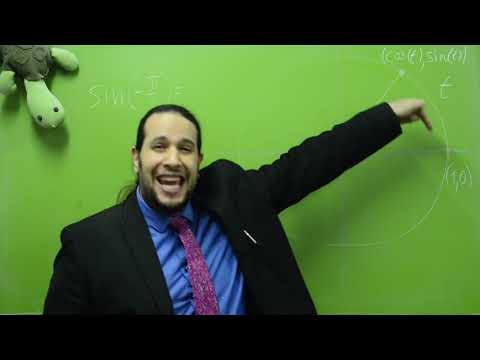
ארז שיינר מגדיר את סינוס, קוסינוס וטנגנס בעזרת מעגל היחידה, ומראה למה זהות פיתגורס נובעת ישירות מנוסחת המרחק (12 דקות).
ערכים מיוחדים
| זווית | [math]\displaystyle{ 0 }[/math] | [math]\displaystyle{ \frac{\pi}{6} }[/math] (30°) | [math]\displaystyle{ \frac{\pi}{4} }[/math] (45°) | [math]\displaystyle{ \frac{\pi}{3} }[/math] (60°) | [math]\displaystyle{ \frac{\pi}{2} }[/math] (90°) |
|---|---|---|---|---|---|
| [math]\displaystyle{ \sin }[/math] | [math]\displaystyle{ 0 }[/math] | [math]\displaystyle{ \frac{1}{2} }[/math] | [math]\displaystyle{ \frac{\sqrt{2}}{2} }[/math] | [math]\displaystyle{ \frac{\sqrt{3}}{2} }[/math] | [math]\displaystyle{ 1 }[/math] |
| [math]\displaystyle{ \cos }[/math] | [math]\displaystyle{ 1 }[/math] | [math]\displaystyle{ \frac{\sqrt{3}}{2} }[/math] | [math]\displaystyle{ \frac{\sqrt{2}}{2} }[/math] | [math]\displaystyle{ \frac{1}{2} }[/math] | [math]\displaystyle{ 0 }[/math] |
| [math]\displaystyle{ \tan }[/math] | [math]\displaystyle{ 0 }[/math] | [math]\displaystyle{ \frac{\sqrt{3}}{3} }[/math] | [math]\displaystyle{ 1 }[/math] | [math]\displaystyle{ \sqrt{3} }[/math] | לא מוגדר |
הזהויות הבסיסיות
[math]\displaystyle{ \sin^2x+\cos^2x=1 }[/math]
[math]\displaystyle{ 1+\tan^2x=\dfrac{1}{\cos^2x} }[/math], כאשר [math]\displaystyle{ \cos x\ne0 }[/math]
[math]\displaystyle{ 1+\cot^2x=\dfrac{1}{\sin^2x} }[/math], כאשר [math]\displaystyle{ \sin x\ne0 }[/math]
[math]\displaystyle{ \sin(a\pm b)=\sin a\cos b\pm\cos a\sin b }[/math]
[math]\displaystyle{ \cos(a\pm b)=\cos a\cos b\mp\sin a\sin b }[/math]
[math]\displaystyle{ \tan(a\pm b)=\dfrac{\tan a\pm\tan b}{1\mp\tan a\tan b} }[/math]
[math]\displaystyle{ \sin(-x)=-\sin x,\quad\cos(-x)=\cos x }[/math]
[math]\displaystyle{ \tan(-x)=-\tan x }[/math]
[math]\displaystyle{ \sin(x+2\pi)=\sin x,\quad\cos(x+2\pi)=\cos x }[/math]
[math]\displaystyle{ \tan(x+\pi)=\tan x }[/math]
[math]\displaystyle{ \sin(x+\pi)=-\sin x,\quad\cos(x+\pi)=-\cos x }[/math]
[math]\displaystyle{ \sin\left(\tfrac{\pi}{2}-x\right)=\cos x }[/math]
[math]\displaystyle{ \cos\left(\tfrac{\pi}{2}-x\right)=\sin x }[/math]
[math]\displaystyle{ \sin(\pi-x)=\sin x,\quad\cos(\pi-x)=-\cos x }[/math]
[math]\displaystyle{ \sin\left(x+\tfrac{\pi}{2}\right)=\cos x }[/math]
[math]\displaystyle{ \cos\left(x+\tfrac{\pi}{2}\right)=-\sin x }[/math]
זהויות שנובעות מהבסיסיות
[math]\displaystyle{ \sin2x=2\sin x\cos x }[/math]
[math]\displaystyle{ \cos2x=\cos^2x-\sin^2x }[/math]
[math]\displaystyle{ \cos2x=2\cos^2x-1=1-2\sin^2x }[/math]
[math]\displaystyle{ \tan2x=\dfrac{2\tan x}{1-\tan^2x} }[/math]
[math]\displaystyle{ \sin^2x=\dfrac{1-\cos2x}{2},\qquad\cos^2x=\dfrac{1+\cos2x}{2} }[/math]
[math]\displaystyle{ \left|\sin\tfrac{x}{2}\right|=\sqrt{\dfrac{1-\cos x}{2}} }[/math]
[math]\displaystyle{ \left|\cos\tfrac{x}{2}\right|=\sqrt{\dfrac{1+\cos x}{2}} }[/math]
[math]\displaystyle{ \tan\tfrac{x}{2}=\dfrac{\sin x}{1+\cos x}=\dfrac{1-\cos x}{\sin x} }[/math]
[math]\displaystyle{ \sin a\sin b=\tfrac{1}{2}\left[\cos(a-b)-\cos(a+b)\right] }[/math]
[math]\displaystyle{ \cos a\cos b=\tfrac{1}{2}\left[\cos(a-b)+\cos(a+b)\right] }[/math]
[math]\displaystyle{ \sin a\cos b=\tfrac{1}{2}\left[\sin(a+b)+\sin(a-b)\right] }[/math]
[math]\displaystyle{ \sin a+\sin b=2\sin\tfrac{a+b}{2}\cos\tfrac{a-b}{2} }[/math]
[math]\displaystyle{ \sin a-\sin b=2\cos\tfrac{a+b}{2}\sin\tfrac{a-b}{2} }[/math]
[math]\displaystyle{ \cos a+\cos b=2\cos\tfrac{a+b}{2}\cos\tfrac{a-b}{2} }[/math]
[math]\displaystyle{ \cos a-\cos b=-2\sin\tfrac{a+b}{2}\sin\tfrac{a-b}{2} }[/math]
[math]\displaystyle{ \sin3x=3\sin x-4\sin^3x }[/math]
[math]\displaystyle{ \cos3x=4\cos^3x-3\cos x }[/math]
[math]\displaystyle{ \sin x=\dfrac{2t}{1+t^2},\qquad\cos x=\dfrac{1-t^2}{1+t^2} }[/math]
[math]\displaystyle{ \tan x=\dfrac{2t}{1-t^2},\qquad dx=\dfrac{2\,dt}{1+t^2} }[/math]
ההצבה נכונה בתחום [math]\displaystyle{ -\pi<x<\pi }[/math].
במשולש
במשולש שצלעותיו [math]\displaystyle{ a,b,c }[/math], הזוויות שמולן [math]\displaystyle{ \alpha,\beta,\gamma }[/math] ורדיוס המעגל החוסם [math]\displaystyle{ R }[/math]:
[math]\displaystyle{ \dfrac{a}{\sin\alpha}=\dfrac{b}{\sin\beta}=\dfrac{c}{\sin\gamma}=2R }[/math]
[math]\displaystyle{ c^2=a^2+b^2-2ab\cos\gamma }[/math]
שטח המשולש: [math]\displaystyle{ S=\tfrac{1}{2}ab\sin\gamma }[/math]
נוסחת אוילר
בעזרת מספרים מרוכבים אפשר לשחזר את כל הזהויות מנוסחה אחת:
[math]\displaystyle{ e^{ix}=\cos x+i\sin x }[/math]
[math]\displaystyle{ \cos x=\dfrac{e^{ix}+e^{-ix}}{2},\qquad\sin x=\dfrac{e^{ix}-e^{-ix}}{2i} }[/math]
למשל, מהשוויון [math]\displaystyle{ e^{i(a+b)}=e^{ia}e^{ib} }[/math] מקבלים את נוסחאות סכום הזוויות בבת אחת: משווים את החלק הממשי ואת החלק המדומה של שני האגפים. באותה דרך, מנוסחת דה־מואבר [math]\displaystyle{ (\cos x+i\sin x)^n=\cos nx+i\sin nx }[/math] מקבלים את הזוויות הכפולה והמשולשת.
פונקציות טריגונומטריות הופכיות
[math]\displaystyle{ \arcsin x+\arccos x=\dfrac{\pi}{2}\quad(-1\le x\le1) }[/math]
[math]\displaystyle{ \arctan x+\arctan\dfrac{1}{x}=\dfrac{\pi}{2}\quad(x>0) }[/math]
[math]\displaystyle{ \sin(\arccos x)=\cos(\arcsin x)=\sqrt{1-x^2} }[/math]
[math]\displaystyle{ \cos(\arctan x)=\dfrac{1}{\sqrt{1+x^2}},\qquad\sin(\arctan x)=\dfrac{x}{\sqrt{1+x^2}} }[/math]
השורשים חיוביים, כי [math]\displaystyle{ \arcsin x }[/math] נמצא בקטע [math]\displaystyle{ [-\frac{\pi}{2},\frac{\pi}{2}] }[/math], ושם הקוסינוס אינו שלילי. בדומה, [math]\displaystyle{ \arccos x }[/math] נמצא בקטע [math]\displaystyle{ [0,\pi] }[/math], ושם הסינוס אינו שלילי. הסבר מלא בדף פונקציה הופכית: arcsin, arccos, arctan ובסרטון ▶ הפונקציות הטריגונומטריות ההופכיות.
נגזרות
[math]\displaystyle{ (\sin x)'=\cos x,\qquad(\cos x)'=-\sin x }[/math]
[math]\displaystyle{ (\tan x)'=\dfrac{1}{\cos^2x}=1+\tan^2x }[/math]
[math]\displaystyle{ (\arcsin x)'=\dfrac{1}{\sqrt{1-x^2}},\qquad(\arctan x)'=\dfrac{1}{1+x^2} }[/math]
הטבלה המלאה וההוכחות נמצאות בדף טבלת נגזרות. אפשר גם לצפות בסרטון ▶ הנגזרת של סינוס, לוג ואקספוננט.
טעויות נפוצות
- [math]\displaystyle{ \sin(a+b)\ne\sin a+\sin b }[/math]. למשל, עבור [math]\displaystyle{ a=b=\frac{\pi}{2} }[/math] האגף השמאלי הוא [math]\displaystyle{ \sin\pi=0 }[/math], והימני הוא [math]\displaystyle{ 2 }[/math].
- [math]\displaystyle{ \sin2x\ne2\sin x }[/math]. הנכון הוא [math]\displaystyle{ \sin2x=2\sin x\cos x }[/math].
- [math]\displaystyle{ \sin^2x }[/math] פירושו [math]\displaystyle{ (\sin x)^2 }[/math], ואילו [math]\displaystyle{ \sin x^2 }[/math] פירושו [math]\displaystyle{ \sin(x^2) }[/math].
- [math]\displaystyle{ \sin^{-1}x }[/math] הוא בדרך כלל [math]\displaystyle{ \arcsin x }[/math], ולא [math]\displaystyle{ \frac{1}{\sin x} }[/math].
- בחדו"א עובדים ברדיאנים. הגבול [math]\displaystyle{ \lim_{x\to0}\frac{\sin x}{x}=1 }[/math] והנגזרת [math]\displaystyle{ (\sin x)'=\cos x }[/math] נכונים רק כשהזווית נמדדת ברדיאנים.
ראו גם
- פונקציות טריגונומטריות: ההגדרה בעזרת מעגל היחידה, והגבול [math]\displaystyle{ \frac{\sin x}{x} }[/math]
- טבלת נגזרות
- פונקציה הופכית: arcsin, arccos, arctan
- חדוא 1 - ארז שיינר: כל החומר לקורס, כולל סרטונים ומבחנים