בקצרה:פונקציות טריגונומטריות (סינוס, קוסינוס וטנגנס) מוגדרות בקורס בעזרת מעגל היחידה: הולכים על מעגל היחידה מרחק [math]\displaystyle{ x }[/math] מהנקודה [math]\displaystyle{ (1,0) }[/math], והסינוס והקוסינוס של [math]\displaystyle{ x }[/math] הם הגובה של הנקודה שמגיעים אליה והמיקום שלה על ציר ה־[math]\displaystyle{ x }[/math]; הטנגנס הוא המנה של הסינוס בקוסינוס. מההגדרה נובעות תכונות הזוגיות והמחזוריות, זהות פיתגורס והחסימות, ולצדן יש כמה זהויות טריגונומטריות (סכום זוויות, זווית כפולה) שצריך לדעת בעל פה, כי כל השאר נובעות מהן. הגבול sin(x)/x, כלומר [math]\displaystyle{ \lim_{x\to0}\frac{\sin x}{x}=1 }[/math], מוכח בהשוואת שטחים ובמשפט הסנדוויץ', והוא נכון רק כשהזווית נמדדת ברדיאנים (אורך הקשת על המעגל); עליו נשענים חישובי הגבולות הטריגונומטריים, ובפרק הבא גם הנגזרת של הסינוס.
סינוס וקוסינוס לפי מעגל היחידה
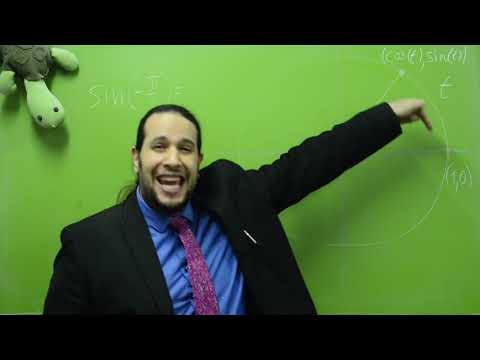
▶ ההרצאה: הפונקציות הטריגונומטריות
משמאל: ההגדרה לפי מעגל היחידה. הולכים מהנקודה [math]\displaystyle{ A=(1,0) }[/math] מרחק [math]\displaystyle{ x }[/math] על המעגל נגד כיוון השעון (הקשת המודגשת) ומגיעים לנקודה [math]\displaystyle{ D=(\cos x,\sin x) }[/math]: הגובה שלה הוא [math]\displaystyle{ \sin x }[/math], והמיקום שלה על ציר ה־[math]\displaystyle{ x }[/math] הוא [math]\displaystyle{ \cos x }[/math]. הקטע [math]\displaystyle{ AB }[/math] על המשיק למעגל ב־[math]\displaystyle{ A }[/math] אורכו [math]\displaystyle{ \tan x }[/math]. המשולש [math]\displaystyle{ OAD }[/math] מוכל בגזרה [math]\displaystyle{ OAD }[/math] (התכלת הכהה), והגזרה מוכלת במשולש [math]\displaystyle{ OAB }[/math] (התכלת הבהירה); מהשוואת השטחים מתקבל [math]\displaystyle{ \sin x<x<\tan x }[/math] לכל [math]\displaystyle{ 0<x<\frac{\pi}{2} }[/math], וזה הצעד הראשון בהוכחת הגבול. מימין: הגרף של [math]\displaystyle{ \frac{\sin x}{x} }[/math] (העיגול החלול: הפונקציה אינה מוגדרת ב־[math]\displaystyle{ 0 }[/math]). בקטע [math]\displaystyle{ \left(-\frac{\pi}{2},\frac{\pi}{2}\right) }[/math] הוא כלוא בין [math]\displaystyle{ \cos x }[/math] ל־[math]\displaystyle{ 1 }[/math] (הרצועה הצבועה), ושתיהן שואפות ל־[math]\displaystyle{ 1 }[/math] כאשר [math]\displaystyle{ x\to0 }[/math]; זה הסנדוויץ' שבהוכחה. רחוק מ־[math]\displaystyle{ 0 }[/math] הגרף דועך, כי [math]\displaystyle{ \lim_{x\to\infty}\frac{\sin x}{x}=0 }[/math].
הגדרה 4.4.1סינוס וקוסינוס לפי מעגל היחידה▶ סרטון 0:39
יהי [math]\displaystyle{ x\in\mathbb R }[/math]. נגדיר את [math]\displaystyle{ (\cos(x),\sin(x)) }[/math] להיות הנקודה שאליה נגיע אם נתחיל מהנקודה [math]\displaystyle{ (1,0) }[/math] ונלך על מעגל היחידה (אוסף הנקודות במישור שמרחקן מראשית הצירים הוא [math]\displaystyle{ 1 }[/math]):
(א) אם [math]\displaystyle{ x\ge0 }[/math]: מרחק [math]\displaystyle{ x }[/math] נגד כיוון השעון;
(ב) אם [math]\displaystyle{ x<0 }[/math]: מרחק [math]\displaystyle{ |x| }[/math] עם כיוון השעון.
חשבו לפי ההגדרה (הליכה על מעגל היחידה מהנקודה [math]\displaystyle{ (1,0) }[/math]): (א) [math]\displaystyle{ \cos\left(\frac{\pi}{2}\right) }[/math] ו־[math]\displaystyle{ \sin\left(\frac{\pi}{2}\right) }[/math]; (ב) [math]\displaystyle{ \cos(\pi) }[/math] ו־[math]\displaystyle{ \sin(\pi) }[/math]; (ג) [math]\displaystyle{ \sin\left(-\frac{3\pi}{2}\right) }[/math]. (ד) היעזרו בטענה 4.4.2 כדי לחשב את [math]\displaystyle{ \sin\left(\frac{7\pi}{2}\right) }[/math] ואת [math]\displaystyle{ \cos(-5\pi) }[/math]. האם [math]\displaystyle{ \tan(\pi) }[/math] ו־[math]\displaystyle{ \tan\left(\frac{\pi}{2}\right) }[/math] מוגדרים? (הטנגנס הוא [math]\displaystyle{ \tan x=\frac{\sin x}{\cos x} }[/math].)
היקף מעגל היחידה הוא [math]\displaystyle{ 2\pi }[/math], ולכן מרחק [math]\displaystyle{ \frac{\pi}{2} }[/math] הוא רבע סיבוב, [math]\displaystyle{ \pi }[/math] הוא חצי סיבוב ו־[math]\displaystyle{ \frac{3\pi}{2} }[/math] הוא שלושה רבעי סיבוב.
(א) רבע סיבוב נגד כיוון השעון מ־[math]\displaystyle{ (1,0) }[/math] מביא לנקודה [math]\displaystyle{ (0,1) }[/math], בראש המעגל. לכן [math]\displaystyle{ \cos\left(\frac{\pi}{2}\right)=0 }[/math] ו־[math]\displaystyle{ \sin\left(\frac{\pi}{2}\right)=1 }[/math].
(ב) חצי סיבוב מביא לנקודה [math]\displaystyle{ (-1,0) }[/math], ולכן [math]\displaystyle{ \cos(\pi)=-1 }[/math] ו־[math]\displaystyle{ \sin(\pi)=0 }[/math].
(ג) [math]\displaystyle{ -\frac{3\pi}{2}<0 }[/math], ולכן הולכים מרחק [math]\displaystyle{ \frac{3\pi}{2} }[/math] עם כיוון השעון: אחרי רבע סיבוב מגיעים ל־[math]\displaystyle{ (0,-1) }[/math], אחרי חצי סיבוב ל־[math]\displaystyle{ (-1,0) }[/math], ואחרי שלושה רבעים ל־[math]\displaystyle{ (0,1) }[/math]. לכן [math]\displaystyle{ \sin\left(-\frac{3\pi}{2}\right)=1 }[/math].
(ד) לפי המחזוריות (פעמיים) ואי־הזוגיות של הסינוס: [math]\displaystyle{ \sin\left(\frac{7\pi}{2}\right)=\sin\left(-\frac{\pi}{2}+4\pi\right) }[/math] [math]\displaystyle{ =\sin\left(-\frac{\pi}{2}\right) }[/math] [math]\displaystyle{ =-\sin\left(\frac{\pi}{2}\right)=-1 }[/math]. לפי הזוגיות והמחזוריות של הקוסינוס: [math]\displaystyle{ \cos(-5\pi)=\cos(5\pi) }[/math] [math]\displaystyle{ =\cos(\pi+4\pi) }[/math] [math]\displaystyle{ =\cos(\pi)=-1 }[/math].
[math]\displaystyle{ \tan(\pi)=\frac{\sin(\pi)}{\cos(\pi)} }[/math] [math]\displaystyle{ =\frac{0}{-1}=0 }[/math], ואילו [math]\displaystyle{ \tan\left(\frac{\pi}{2}\right) }[/math] אינו מוגדר, כי [math]\displaystyle{ \cos\left(\frac{\pi}{2}\right)=0 }[/math].
מקור: תמליל 51 (gnUkKM9PgPQ) 01:49–03:41 (https://www.youtube.com/watch?v=gnUkKM9PgPQ&t=109s): sin π, cos π, sin(π/2), cos(π/2), sin(−π/2), cos(−π/2) לפי הגלגל הענק ("פאי הוא חצי ההיקף של המעגל", 01:55); זוגיות ומחזוריות 03:42–05:49; הגדרת הטנגנס 09:23 (https://www.youtube.com/watch?v=gnUkKM9PgPQ&t=563s); לוח מדמ"ח תשפ"ד ל12 ע74 (R5-4.11: cos(π/2)=0, sin(−3π/2)=1, cos π=−1 לפי ההגדרה, בהליכה על המעגל); מאגר ת4-047 (סרטון/ש"ב, ק' 1–2, בוחן ✓). סעיף (ד) נוסף כדי לתרגל את טענה 4.4.2.
(א) הסיקו מנוסחאות סכום הזוויות (טענה 4.4.3) כי לכל [math]\displaystyle{ x\in\mathbb R }[/math] מתקיים [math]\displaystyle{ \sin\left(x+\frac{\pi}{2}\right)=\cos x }[/math] ו־[math]\displaystyle{ \cos\left(x+\frac{\pi}{2}\right)=-\sin x }[/math]. (ב) חשבו את [math]\displaystyle{ \cos\left(\frac{\pi}{4}\right) }[/math], [math]\displaystyle{ \sin\left(\frac{\pi}{4}\right) }[/math] ו־[math]\displaystyle{ \tan\left(\frac{\pi}{4}\right) }[/math] בעזרת נוסחת הזווית הכפולה וזהות פיתגורס. (ג) חשבו את [math]\displaystyle{ \sin\left(\frac{3\pi}{4}\right) }[/math], [math]\displaystyle{ \cos\left(\frac{3\pi}{4}\right) }[/math] ו־[math]\displaystyle{ \tan\left(\frac{3\pi}{4}\right) }[/math].
(א) יהי [math]\displaystyle{ x\in\mathbb R }[/math]. לפי נוסחאות הסכום עם [math]\displaystyle{ b=\frac{\pi}{2} }[/math], ולפי [math]\displaystyle{ \cos\left(\frac{\pi}{2}\right)=0 }[/math] ו־[math]\displaystyle{ \sin\left(\frac{\pi}{2}\right)=1 }[/math] (דוגמה 1): [math]\displaystyle{ \sin\left(x+\frac{\pi}{2}\right)=\sin x\cdot0+1\cdot\cos x }[/math] [math]\displaystyle{ =\cos x }[/math], [math]\displaystyle{ \cos\left(x+\frac{\pi}{2}\right)=\cos x\cdot0-\sin x\cdot1 }[/math] [math]\displaystyle{ =-\sin x }[/math].
(ב) נסמן [math]\displaystyle{ c=\cos\left(\frac{\pi}{4}\right) }[/math] ו־[math]\displaystyle{ s=\sin\left(\frac{\pi}{4}\right) }[/math]. לפי נוסחת הזווית הכפולה [math]\displaystyle{ c^2-s^2=\cos\left(\frac{\pi}{2}\right)=0 }[/math], ולפי זהות פיתגורס [math]\displaystyle{ c^2+s^2=1 }[/math]. מחיבור וחיסור של שתי המשוואות מתקבל [math]\displaystyle{ c^2=s^2=\frac{1}{2} }[/math].
כיוון ש [math]\displaystyle{ 0<\frac{\pi}{4}<\frac{\pi}{2} }[/math], הולכים פחות מרבע סיבוב נגד כיוון השעון, והנקודה [math]\displaystyle{ (c,s) }[/math] נמצאת ברביע הראשון, כלומר [math]\displaystyle{ c>0 }[/math] ו־[math]\displaystyle{ s>0 }[/math]. לכן [math]\displaystyle{ c=s=\frac{1}{\sqrt{2}} }[/math], ו־[math]\displaystyle{ \tan\left(\frac{\pi}{4}\right)=\frac{s}{c}=1 }[/math].
(ג) לפי (א) עם [math]\displaystyle{ x=\frac{\pi}{4} }[/math]: [math]\displaystyle{ \sin\left(\frac{3\pi}{4}\right)=\cos\left(\frac{\pi}{4}\right) }[/math] ו־[math]\displaystyle{ \cos\left(\frac{3\pi}{4}\right)=-\sin\left(\frac{\pi}{4}\right) }[/math]. לכן לפי (ב) [math]\displaystyle{ \sin\left(\frac{3\pi}{4}\right)=\frac{1}{\sqrt{2}} }[/math], [math]\displaystyle{ \cos\left(\frac{3\pi}{4}\right)=-\frac{1}{\sqrt{2}} }[/math] ו־[math]\displaystyle{ \tan\left(\frac{3\pi}{4}\right)=-1 }[/math].
שימו לב: את הזהויות של טענות 4.4.2 ו־4.4.3 צריך לזכור בעל פה; זהויות אחרות, כמו אלה שבסעיף (א), מסיקים מהן.
מקור: הערת המרצה לטענה 4.4.3 ("אין נוסחאון"; כל השאר נובעות מאלה) = לוח מדמ"ח תשפ"ד ל12 ע75–77 (R5-4.12, "זהויות טריגונומטריות שצריך לדעת בעל פה ... כי כל השאר נובעות מאלה"); תמליל 51 (gnUkKM9PgPQ) 05:52–06:41 (https://www.youtube.com/watch?v=gnUkKM9PgPQ&t=352s): זהות פיתגורס מנוסחת המרחק; תמליל 52 (YIU0hc8xe7I) 07:43 ו־08:36: הסינוס והקוסינוס חיוביים ברבע הראשון. החישוב של π/4 ו־3π/4 עצמו אינו בלוחות ובסרטונים; הוא נבנה כאן מהזהויות של הקורס (חישוב שלי).
דוגמה 3: סינוס במעלות: מה מראה המחשבון?
בסרטון (10:28) המרצה מציע להציב במחשבון ערכים קרובים ל־[math]\displaystyle{ 0 }[/math], פעם כשהמחשבון מכוון לרדיאנים ופעם כשהוא מכוון למעלות. מחשבון שמכוון למעלות מחשב בעצם את הפונקציה [math]\displaystyle{ \sin_D(x)=\sin\left(\frac{\pi}{180}x\right) }[/math], הסינוס של זווית בת [math]\displaystyle{ x }[/math] מעלות. (א) חשבו את [math]\displaystyle{ \lim_{x\to0}\frac{\sin_D(x)}{x} }[/math] ואת [math]\displaystyle{ \lim_{x\to0}\frac{x}{\sin_D(x)} }[/math]. (ב) הסבירו מדוע ברדיאנים מתקבל [math]\displaystyle{ \frac{\sin(0.001)}{0.001}\approx0.99999983 }[/math], ובמעלות מתקבל [math]\displaystyle{ 0.017453\ldots }[/math].
(א) תהי [math]\displaystyle{ x_n }[/math] סדרה כך ש [math]\displaystyle{ x_n\ne0 }[/math] לכל [math]\displaystyle{ n\in\mathbb N }[/math] ו־[math]\displaystyle{ x_n\to0 }[/math], ונסמן [math]\displaystyle{ t_n=\frac{\pi}{180}x_n }[/math]. אזי [math]\displaystyle{ t_n\ne0 }[/math] לכל [math]\displaystyle{ n\in\mathbb N }[/math] ו־[math]\displaystyle{ t_n\to0 }[/math], ולכן לפי משפט 4.4.4 והגדרת הגבול לפי היינה [math]\displaystyle{ \frac{\sin(t_n)}{t_n}\to1 }[/math].
לכן, לפי אריתמטיקה של גבולות: [math]\displaystyle{ \frac{\sin_D(x_n)}{x_n}=\frac{\sin(t_n)}{x_n} }[/math] [math]\displaystyle{ =\frac{\pi}{180}\cdot\frac{\sin(t_n)}{t_n} }[/math] [math]\displaystyle{ \to\frac{\pi}{180}\cdot1=\frac{\pi}{180} }[/math].
זה נכון לכל סדרה כזו, ולכן לפי היינה [math]\displaystyle{ \lim_{x\to0}\frac{\sin_D(x)}{x}=\frac{\pi}{180} }[/math], ו־[math]\displaystyle{ \frac{\pi}{180}\approx0.017453 }[/math]. כיוון ש [math]\displaystyle{ \frac{\pi}{180}\ne0 }[/math], לפי אריתמטיקה של גבולות (מנה) [math]\displaystyle{ \lim_{x\to0}\frac{x}{\sin_D(x)}=\frac{180}{\pi} }[/math], ו־[math]\displaystyle{ \frac{180}{\pi}\approx57.3 }[/math].
(ב) ברדיאנים [math]\displaystyle{ \frac{\sin x}{x}\to1 }[/math], ולכן ליד [math]\displaystyle{ 0 }[/math] המנה קרובה ל־[math]\displaystyle{ 1 }[/math]. במעלות המחשבון מחשב את [math]\displaystyle{ \frac{\sin_D(x)}{x} }[/math], ולפי (א) המנה קרובה ל־[math]\displaystyle{ \frac{\pi}{180} }[/math].
המסקנה: הגבול [math]\displaystyle{ \lim_{x\to0}\frac{\sin x}{x}=1 }[/math] נכון רק ברדיאנים, שבהם הזווית היא אורך הקשת על מעגל היחידה. מאותה סיבה, רק ברדיאנים הנגזרת של [math]\displaystyle{ \sin x }[/math] היא [math]\displaystyle{ \cos x }[/math] (פרק 5).
מקור: תמליל 52 (YIU0hc8xe7I) 10:28–10:48 (https://www.youtube.com/watch?v=YIU0hc8xe7I&t=628s): "תנסו להציב במקום X ערכים קרובים ל-0 בביטוי הזה ותחליפו את המחשבון מרדיאנים למעלות", ו־11:54 ("ברדיאנים כמובן"); לוח מדמ"ח תשפ"א 22.12.20 (R2-E61: sin_D(x)=sin(πx/180), הגבול π/180 בכפל וחילוק); לוח מדמ"ח תשפ"ד ל13 ע78 (R5-4.14: sin(0.001)/0.001 = 0.999 או 0.0174 = π/180, "המחשבון היה במעלות"); מאגר ת4-044 (ק' 1–2, בוחן ✓). ההצבה נעשית כאן דרך היינה (בלוח: כפל וחילוק ב־π/180).
דוגמה 4: שאלת בוחן: [math]\displaystyle{ \frac{x\sin(2x)}{1-\cos x} }[/math]
חשבו את הגבול [math]\displaystyle{ \lim_{x\to0}\frac{x\sin(2x)}{1-\cos x} }[/math] בלי כלל לופיטל.
הכנה. לכל [math]\displaystyle{ 0<x<\frac{\pi}{2} }[/math] מתקיים [math]\displaystyle{ \sin x>0 }[/math], והסינוס אי־זוגית, ולכן [math]\displaystyle{ \sin x\ne0 }[/math] לכל [math]\displaystyle{ 0<|x|<\frac{\pi}{2} }[/math]. לפי זהות פיתגורס [math]\displaystyle{ \cos^2x=1-\sin^2x<1 }[/math] שם, ולכן [math]\displaystyle{ 1-\cos x\ne0 }[/math] ו־[math]\displaystyle{ 1+\cos x\ne0 }[/math].
לפי משפט 4.4.4 ואריתמטיקה של גבולות (מנה, והגבול במכנה [math]\displaystyle{ 1\ne0 }[/math]) מתקיים [math]\displaystyle{ \frac{x}{\sin x}\to\frac{1}{1}=1 }[/math]. בהוכחת המשפט ראינו גם ש [math]\displaystyle{ \lim_{x\to0}\cos x=1 }[/math] (בסרטון, 08:17–09:20, הגבול מימין; הגבול משמאל שווה לו כי הקוסינוס זוגית).
לכן, לפי אריתמטיקה של גבולות: [math]\displaystyle{ \lim_{x\to0}\frac{x\sin(2x)}{1-\cos x} }[/math] [math]\displaystyle{ =2\cdot1\cdot1\cdot(1+1)=4 }[/math].
מקור: בוחן מועד א' תשע"ח, מתמטיקה א' לביולוגים 80-130 (ארז), שאלה 5, עם פתרון (R8a #30 ש5: "מותר להם להשתמש בנוסחת זווית כפולה שחולקה להם"); אותו גבול מופיע ברשימת הווריאנטים של משפחת "WIN" במאגר ת4-042 ובסעיף 4.4 של טיוטת "מבחנים לפי נושא"; שיטת הצמוד: מאגר ת4-041 (XI X80, (1−cos ax)/(bx²) בלי לופיטל); הגבול lim cos x = 1: תמליל 52 (YIU0hc8xe7I) 08:17–09:20 (https://www.youtube.com/watch?v=YIU0hc8xe7I&t=497s).
טעויות נפוצות
לחשב במעלות: הגבול [math]\displaystyle{ \lim_{x\to0}\frac{\sin x}{x}=1 }[/math] נכון רק כש־[math]\displaystyle{ x }[/math] נמדד ברדיאנים (אורך הקשת על מעגל היחידה); אם מודדים במעלות הגבול הוא [math]\displaystyle{ \frac{\pi}{180} }[/math] (דוגמה 3).
לכתוב [math]\displaystyle{ \lim_{x\to\infty}\frac{\sin x}{x}=1 }[/math]: הגבול [math]\displaystyle{ 1 }[/math] הוא רק כאשר [math]\displaystyle{ x\to0 }[/math]; כאשר [math]\displaystyle{ x\to\infty }[/math] זו פונקציה חסומה חלקי פונקציה ששואפת לאינסוף, והגבול הוא [math]\displaystyle{ 0 }[/math] (בסרטון, 12:03: "בלבול נפוץ").
"לצמצם" את ה־[math]\displaystyle{ x }[/math] ב־[math]\displaystyle{ \frac{\sin x}{x} }[/math]: [math]\displaystyle{ \sin x }[/math] אינו מכפלה של [math]\displaystyle{ \sin }[/math] ב־[math]\displaystyle{ x }[/math] אלא הערך של פונקציה ב־[math]\displaystyle{ x }[/math], ולכן אין מה לצמצם (בסרטון, 12:33, על מי שחותך את הקשת: "תישארו רק עם סין, שזה חטא").
להוכיח את [math]\displaystyle{ \lim_{x\to0}\frac{\sin x}{x}=1 }[/math] בכלל לופיטל: זו הוכחה מעגלית, כי בהוכחה ש [math]\displaystyle{ \sin'(x)=\cos(x) }[/math] משתמשים בגבול הזה עצמו.
לזכור זהות "בערך", למשל [math]\displaystyle{ \sin(a+b)=\sin a+\sin b }[/math]: עבור [math]\displaystyle{ a=b=\frac{\pi}{2} }[/math] האגף השמאלי הוא [math]\displaystyle{ \sin(\pi)=0 }[/math] והימני [math]\displaystyle{ 2 }[/math]. אין נוסחאון, ואת הזהויות של טענה 4.4.3 צריך לדעת בעל פה; כל השאר נובעות מהן (דוגמה 2).
לתרגול
מועד א' תשפ"ה (מתמטיקה, בועז צבאן) · חלק נכון/לא נכון, סעיף י: [math]\displaystyle{ \sin x<x<\tan x }[/math] לכל [math]\displaystyle{ 0<x<\frac{\pi}{2} }[/math] (פתרון)
מועד ב' תשפ"א (החממה) · שאלה 1א: הגבול ב־[math]\displaystyle{ 0 }[/math] של [math]\displaystyle{ \frac{1-\cos^2x}{xe^{3x}-xe^{-x}} }[/math] (פתרון); נדרש גם הגבול [math]\displaystyle{ \frac{e^x-1}{x}\to1 }[/math] מפרק 5
מבחן לדוגמא תש"ף (מדמ"ח) · שאלה 1ג: מנה של גבולות יסודיים, עם [math]\displaystyle{ 1-\cos(3x) }[/math] במכנה (פתרון)
מועד א' סמסטר ב' תשפ"ד (מדמ"ח) · שאלה 1א: הגבול ב־[math]\displaystyle{ 0 }[/math] של [math]\displaystyle{ \frac{\sin(2\sin x)\ln(1+5x)}{(e^{3x}-1)^2} }[/math] (בלי פתרון)
מערך תרגול · מערך התרגול של הקורס (תשע"ב), פרק הפונקציות
מערך תרגול: גבול פונקציה · הרשימה "גבולות ידועים" והדוגמאות [math]\displaystyle{ \frac{1-\cos x}{\sin x}\to0 }[/math] ו־[math]\displaystyle{ x\sin\left(\frac{1}{x}\right)\to1 }[/math] כאשר [math]\displaystyle{ x\to\infty }[/math], עם פתרונות